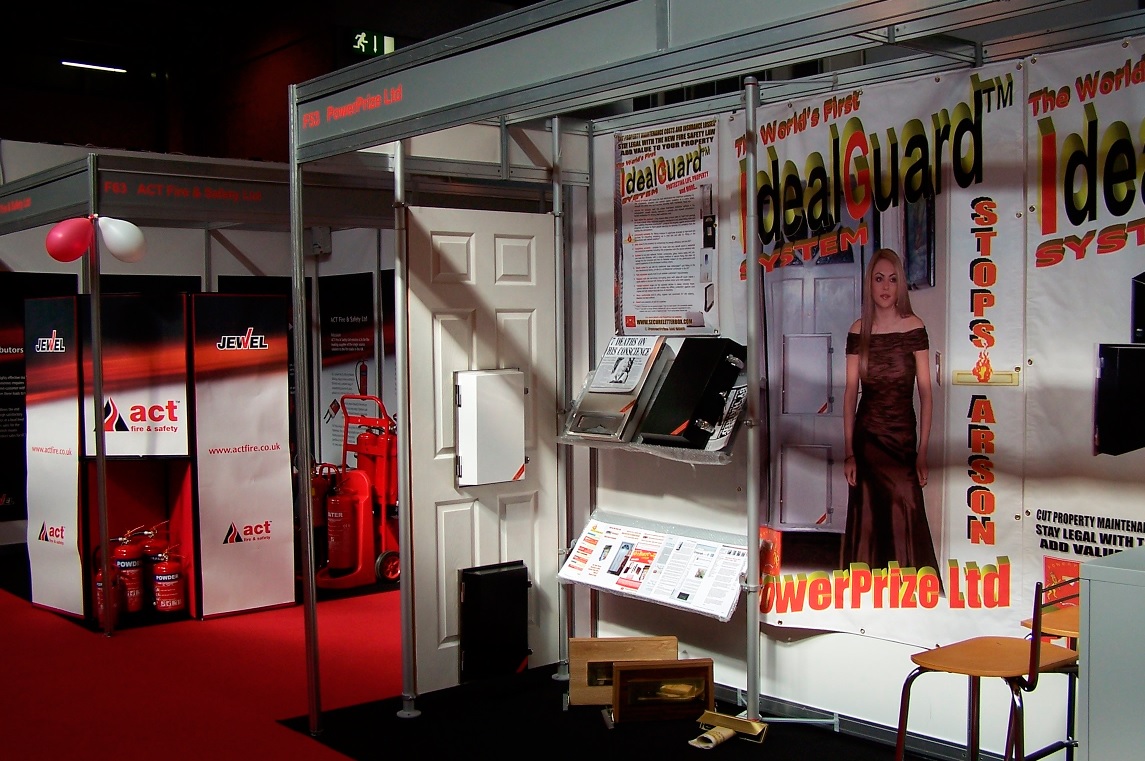
It's smart. It's simple. It works.
No Analogues in the World
Powered by the Force of Gravity
Focusing on Prevention of All Risks
IdealGuard™ brand has delivered next-generation letter/mailbox products for arson prevention, fire protection, security, energy-saving, cutting CO2 emissions, and more. They are built for customers, who demand the most superior performance and the best value for money rather than superficial assessments and false promises.
The IdealGuard™
line of patented secure by design letter/mail products is the most advanced and efficient letter/mailbox products line ever created.
Multifunctional they are lifesaving, money-saving and cut CO2 emissions without compromising traditional mail delivery.
What is innovative about it?
IdealGuard™ is a new
eco-innovation brand that is built on a number of great British inventions that deliver real security and proven cost and energy savings.
These unprecedented products are the world's first to banish liquids from the letter/mailbox and remarkably suitable for fitting at any level (high- and low-) with no added damage to the door structure.
IdealGuard™ secure by design letter box products work in conjunction with the traditional letter plate so the door's external appearance remains traditional and mail deliveries are not impeded. It is only when the letter plate is opened (simply by pushing it without twisting your hand) it would appear that the flap is hinged at the bottom instead of the top, making it very difficult to introduce liquids. The extent of the flap opening is adjustable and enough for introducing most of the mail items, which are flexible, but too small for allowing most solid hazards.
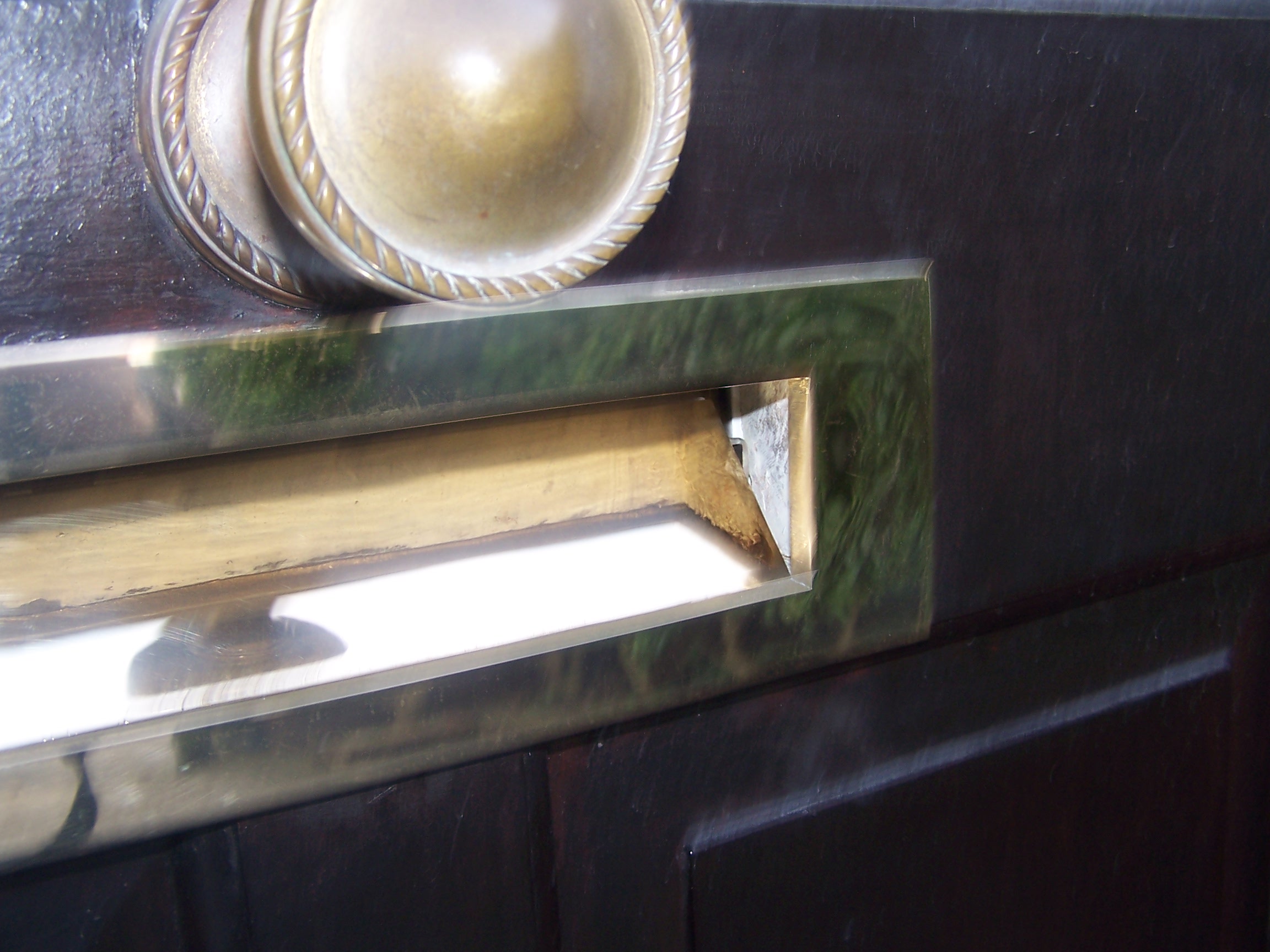
The multiple benefits of full insulation, draught and flood proofing in the letterbox, along with protection against mail theft, improved hygiene and comfort (mail does not fall on the floor), utmost security and passive fire protection for the property are delivered by a single stylish maintenance-free product without the need to replace the door and change your behaviour. This is innovation along with British tradition.
Tackling fire safety issues
For providing the utmost security IdealGuard™ secure by design products work by relying on the force of gravity for eliminating hazards, especially all liquids, and most solid hazards at letter plate point rather than the outdated products, which are focusing on containing hazards in the letter/mailbox first and then trying to cope after there is a developed problem, such as a fire or an explosion.
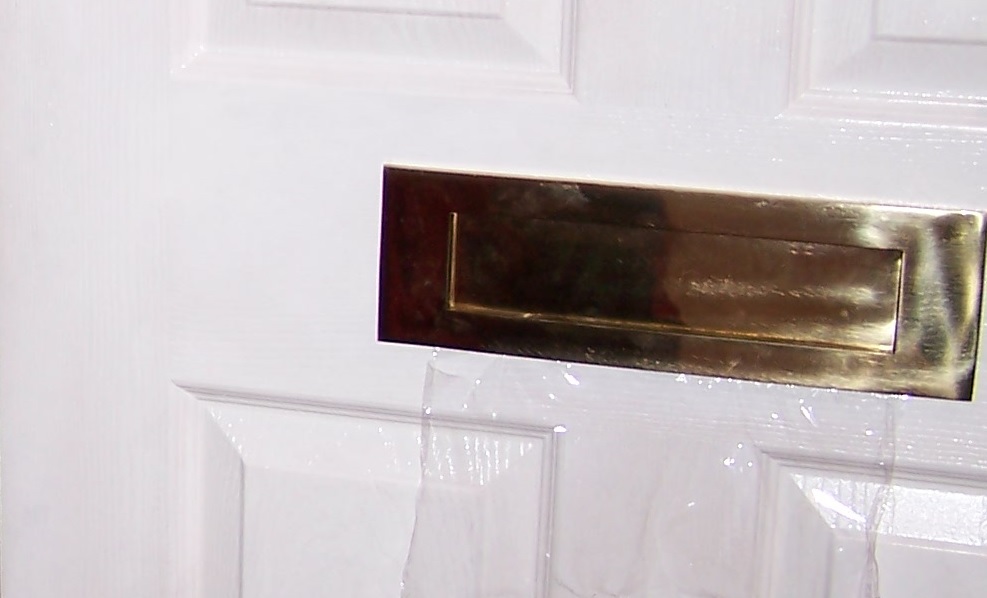
By ruling out most hazards, IdealGuard™ secure by design letter box prevents most of the real world accidents, including the most dangerous, in which litres of liquid accelerant are poured in and ignited.
Should liquid be somehow introduced, it will run out due to the force of gravity on the feet of whoever has introduced it. A strong steel product body provides further protection. Problem solved.
Only IdealGuard™ brand products can deliver this utmost security
Most doors, advertised as 'eco doors' or 'secure', are not eco and not secure if they come with an unprotected letter plate. Fitting IdealGuard™ secure by design multifunctional eco letter/mailbox is a simple and cost-effective all-encompassing solution to all letter plate related problems that does not jeopardise traditional mail delivery.
The product can pay for itself in 2-3 years just from the savings on the property's energy bills. You don't have to take our word for it. This was proven during the 5-year period of monitoring the example property in London.
The savings on energy bills will escalate year after year during the product's estimated over 20-years lifetime. In addition, as draught-free homes are comfortable at lower temperatures, according to The Energy Saving Trust, you will be able to turn down your thermostat and this could save you an additional 10% of your annual bill per 1°C per year.
IdealGuard™/U universal models can be fitting as a letter box indoors by attaching to the matching external letter plate, or as a surface mounted or recessed mailbox both indoors and outdoors. Mailbox fitting on a stand either outdoors or indoors is also possible. Moreover, all these options allow a reverse fitting in the position of a conventional letter/mailboxes with reduced security against the introduction of liquids but with increased capacity for mail.
Furthermore, the IdealGuard™/U, /M, /L and /S models of this integrated product are versatile and multifunctional, with wider additional benefits such as 30(W) cm x 34(H) cm x 4(D) cm of interior vacant space.
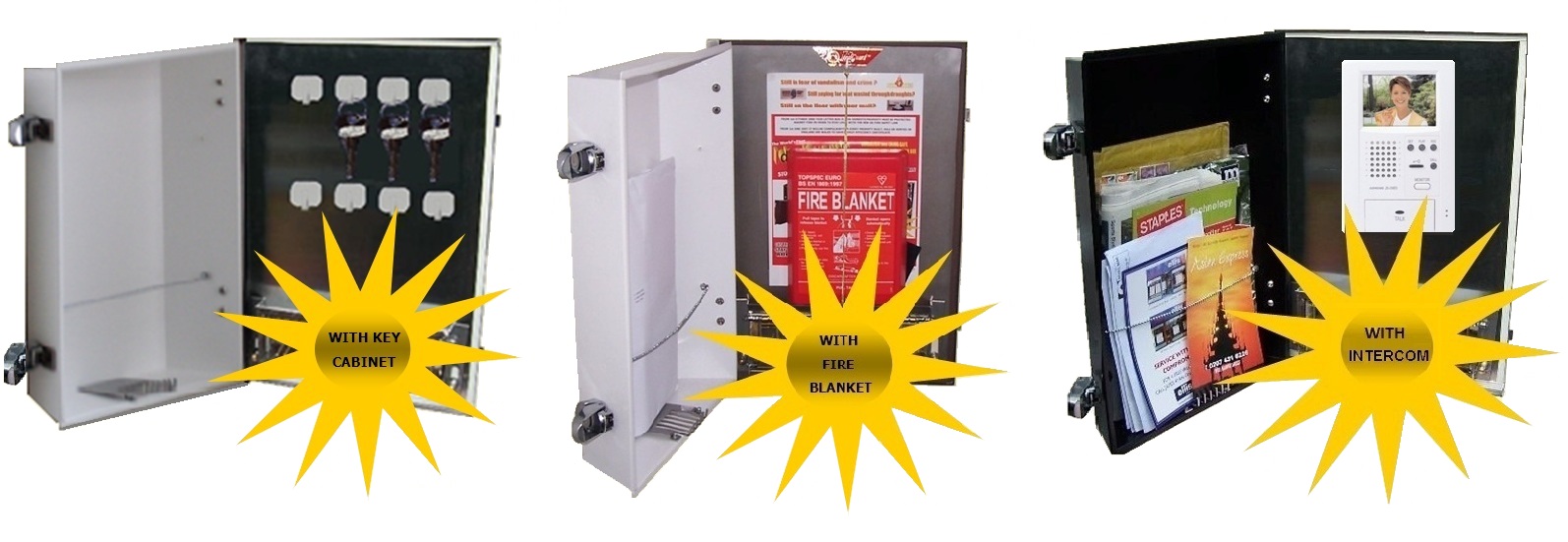
Where are your first aid items located? Where do you keep outgoing mail items? This bonus vacant space can be used for housing various items, such as disinfectant and/or sanitising means, first aid kit, outgoing mail, key cabinet, the Premises information documents, wireless energy monitor, and also for convergence between physical security and electronic security solutions, such as CCTV, alarm, access control, entry phone, and more. The true potential of the products is vast and thought-provoking.
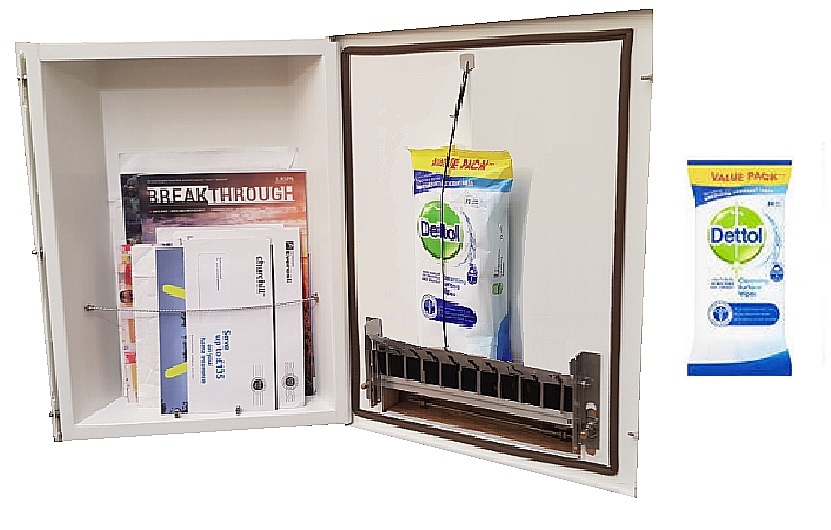
The mail items may have surfaces contaminated by viruses and bacteria that can survive outside the body for a few hours
or up to several days. As the product catches mail, keeps it away from the floor and the pets, it reduces the risk of spreading viruses and bacteria from contaminated mail surfaces.
By delaying collecting the stored mail, there is a greater chance that they will die naturally. Also, by housing the disinfectant and/or sanitiser means you will have them handy for treating the stored mail items and/or sanitising hands after contacting them.
Premises information documents, such as building handbook, plans and information about life-threatening situations, can be made easily accessible for the emergency services if they are housed in IdealGuard™ mailbox or letter box. It will provide invaluable support to the emergency services in case of an incident, such as fire, medical emergency or flood, as it can be used to determine the priority of actions.
To view IdealGuard™ products' benefits click Benefits.