
Specifying IdealGuardTM
Are you looking to reduce the risks to your residential and business property?
The publicly accessible letter plate is a feature of an entrance/exit door that can create a problem since it will undermine the vital specifications of the door, including security, fire resistance and environmental.
The fire entrance/exit doors to flats that failed the tests by the Metropolitan Police after the Grenfell fire are believed to have a role in undermining the compartmentation of flats and fire protection of the common escape route.
Such doors are not compliant with a number of the current mandatory requirements imposed by the Building Regulation 2010 Approved Document B for fire safety, Approved Document L for thermal insulation and Approved Document Q for security. Also importantly, these doors are not compliant with the Fire Safety and Building Safety Bills.
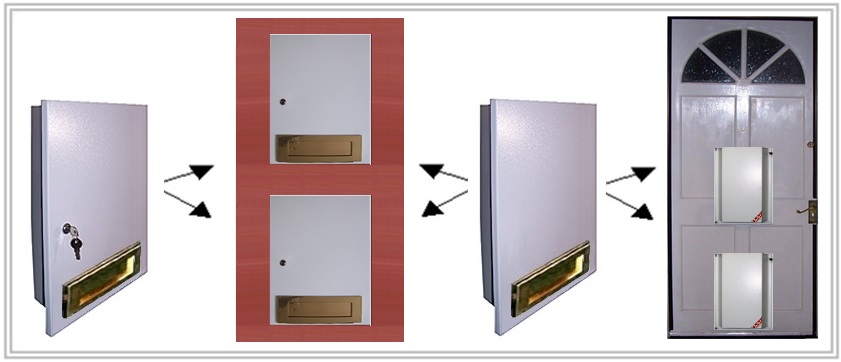
IdealGuard™ products for safeguarding the letterbox are suitable for fitting to almost any door with a letter plate as a retrofit or new installation by a contractor or DIY. The letter plate can be positioned at high or low level too, which is a unique feature among anti-arson letter box products. Installing IdealGuard™ anti-arson security product to the letterbox in your entrance/exit door is a simple and cost-effective way to eliminate or considerably reduce letter plate-related risks to your property while still receiving mail indoors.
IdealGuard™/U universal models presented on this website are anti-arson, anti-virus, anti-bacterial, fireproof, anti-burglary, anti-fireworks, anti-mail theft, anti-vandal, floodproof, anti-terrorist, can save house heat and cut CO2 emissions into the atmosphere
Anti-arson means
that the product is designed to prevent arson attempts through the letterbox
or mailbox. Uniquely, in IdealGuard™ products this is accomplished by filtering out most
hazards at the letter plate point. Products are also designed to prevent the spread of smoke and fire that may somehow originate inside the product, out into the property. This is achieved with the products' tightly sealed strong steel body.
Anti-virus, Anti-bacterial means that the product catches mail, keeps it away from the floor and the pets, and reduces the risk of spreading viruses and bacteria from contaminated mail surfaces. Furthermore, the bonus vacant space can be used for housing disinfectant and/or sanitising means that will be handy for treating the stored mail items and/or sanitising hands after contacting them.
Fireproof means that IdealGuard™ product fitted to a letterbox will protect against fire and smoke that may originate on either side of the door: in the flat or in the common areas. Usually, this is essential for the so-called 'compartmentation of flats' with entrance doors facing the common areas.
Anti-burglary means that IdealGuard™ product fitted to a letterbox does not allow access to door locks through the letter plate or 'fishing' of keys in order to open the locks.
Anti-mail theft means that IdealGuard™ products resist the attempts to steal mail items through the letter plate.
Anti-theft means that IdealGuard™ products do not allow theft of items by 'fishing' them out through the letter plate.
Flood-proof means that IdealGuard™ products do not allow water penetration through the letter plate into the property.
Anti-vandal and Anti-terrorist mean that IdealGuard™ products offer protection against all other known categories of crime and vandalism through the letter plate.
IdealGuard™ products will fully insulate the letterbox even when the letter plate flap is open. This allows for energy savings in the home as well as a reduction in CO2 emissions from the property.
Modular anti-theft security
Security against mail theft through the letter plate is available in IdealGuard™ products on a modular principle depending on the security attachments used. Three levels of security against mail theft are available: enhanced, superior and ultimate:
- enhanced security against mail theft is available in IdealGuard™/UE, IdealGuard™/LE (and /SE) models, which can be fitted to a letterbox, and in IdealGuard™/ME mailbox;
- superior security against mail theft is available in IdealGuard™/US, IdealGuard™/LS (and /SS) models, which can be fitted to a letterbox, and in IdealGuard™/MS mailbox;
- ultimate security against mail theft is available in IdealGuard™/UU, IdealGuard™/LU (and /SU) models, which can be fitted to a letterbox or as a mailbox.
Mail theft by using fingers is not possible with all levels of security. With a superior level of security, attempting mail theft would be really challenging, even by using implements. With the ultimate level of security, mail theft is not considered as possible. Furthermore, IdealGuard™ products can be successfully customised and new features added.
Letter plate Specifications
IdealGuard™ models presented on this website are compatible with a matching 4"x12" Victorian letter plate, which can be installed at high and low levels. Other than IdealGuard™ products, no other products on the market are suitable for low-level installation. The letter plate is fitted with the axle of the flap in a position near the low long side of the mail slot, and the flap is openable inwards into the mail slot.
The matching 4"x12" Victorian letter plate is of standard type, which is available on the market in various finishes, such as Polished Brass, Polished Chrome, Satin Chrome, Polished Nickel, etc. Polished Brass Lacquered letter plate is available to order from this website. Due to constant development, the IdealGuard™ models are now compatible with letter plates of almost any style. To find out more, you should contact us directly.